

Ballinderry
Houses within 5km of this house
Displaying 7 houses.
Houses within 5km of Ballinderry
Displaying 7 houses.
| House name | Description | |
|---|---|---|
| Ballintober (Kilcumreragh) | Ballintober House is named on both the first edition OS map and the early 20th century 25 inch map, but no longer appears to be extant. In 1837 William Fetherstonhaugh was resident and in the mid-19th century it was the home of James Fetherston Haugh, held from Dorothea Horton and valued at £20. In the 1870s James Fetherstonhaugh of Ballintober owned 39 acres in county Westmeath. Ballintober was still in Fetherston Haugh occupation in 1901 but unoccupied by 1911. This was a branch of the Mosstown and Bracklyn Fetherstonhaugh family. | |
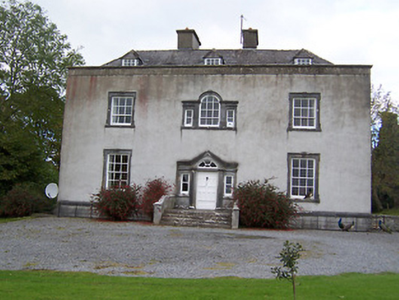
| Rosemount House/Oldcourt | Rose Mount House is also known as Old Court, both names appear on the OS maps. The village nearby is known as Rosemount. Described by buildings of Ireland as a well-balanced structure originally built by the Geoghegan Family in the late eighteenth-century, probably replacing an earlier house. Leet records John Pim occupying a house named Rosemount near Moate in 1814 and Lewis records Lady Nagle as the occupant in 1837. O’Brien writes that it was inherited by the Nugent family of Ballinacor through marriage. At the time of Griffith’s Valuation it was occupied by John J Nugent who held it from the representatives of Sir Richard Nagle. It was valued at £21.10. Still extant and occupied. |
|
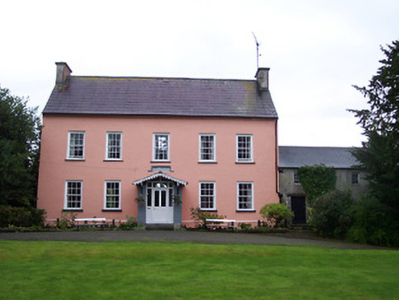
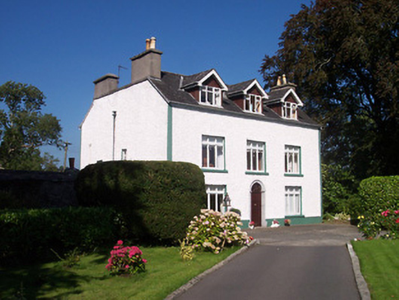
| Grouse Lodge | Grouse Lodge is named on both the first 6 inch and 25 inch OS maps. Described as a three-bay two-storey over basement country house with attic level, built c.1810 (boi), now in use as a residential recording studio. Grouse Lodge was built by a branch of the Fetherstonhaugh Family of Ardagh, County Longford and was occupied by Theodore Fetherston in 1814 and by William Fetherstonhaugh at the time of Griffith’s Valuation. The building valued at £24 was held from Edward Fetherstonhaugh, who was the occupant in 1837. It is still a family home. |

|
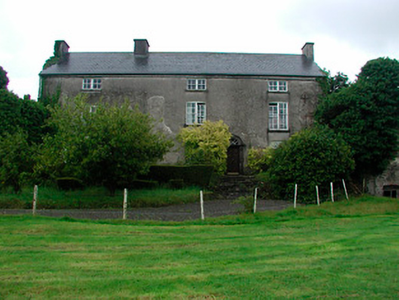
| Moate View | Moate View is situated on the outskirts of the town of Moate and predates much of the town. It is a detached five-bay two-storey house, built 1762, verified by a cut stone date stone inscribed ‘James Clibborn built this house anno domini 1762’. O’Brien writes that James Clibborn was the son of Joshua Clibborn and his wife Sarah Lecky. His second son William Cooper Clibborn inherited the house and was the occupant at the time of Griffith’s Valuation (publ. 1854) holding the building valued at £32 from Thomas H Mulock MP. It is still the home of Clibborn family members. |
|
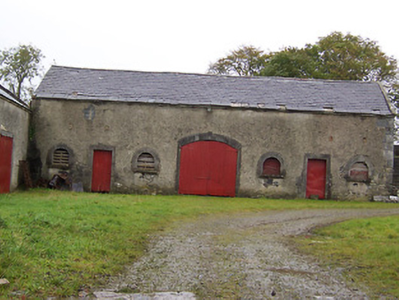
| Moate Castle | A complex structure, of at least three periods of construction, which dominates the centre of the town. It is a two-bay three-storey former fortified house/tower house, built 1550, having a three-bay three-storey wing to the west end, built c.1720 and a two-storey bowed extension to the east end, built c.1760, acquired by Captain John Clibborn in 1659 (boi). In 1814 Thomas C Clibborn occupied Moate-castle and in 1837 Moate Castle was the seat of Cuthbert J Clibborn. At the time of Griffith’s Valuation (publ. 1854) Gilbert Nugent was resident holding the property valued at £23 from the representatives of Cuthbert J Clibborn. Moate Castle has remained a private residence and was for sale in 2023. |
|
| Moyvoughly | Moyvoughly named Moyvoughly Lodge on the first edition OS map and Moyvoughly House on the 25 inch map. O’Brien writes that this was originally Arabin land purchased towards the end of the 18th century by the Grogans. This house was constructed by 1837 as C Arabin was resident, who was probably leasing it from the Grogans. By the time of Griffith’s Valuation (publ. 1854) John Ennis had acquired the house and lands as he is recorded as holding the property in fee . O’Brien writes that he rented the house to William Dargan, the railway entrepreneur, who was building the Mullingar to Dublin railway line and that the land was used to graze and accommodate the horses used in this work. In the mid-1850s Moyvougly was leased to Thomas Maher who eventually purchased the estate. Bought by the Fallon family in the 20th century, the house is now demolished but some outbuildings and stables survive. |
|
| Jones Lake | A house south of the railway line and a short distance west of Moate in the mid-19th century. O'Brien writes that it was built by the Jones family in the mid-18th century as a two storey, three bay building. Leet records William Gustavus Jones as resident in 1814. Occupied by John Sills at the time of Griffith's Valuation (publ. 1854) and held from Patrick Dillon Irwin with about 50 acres, when it was valued at £13. |
|