

Knockdrin Castle
Houses within 5km of this house
Displaying 8 houses.
Houses within 5km of Knockdrin Castle
Displaying 8 houses.
| House name | Description | |
|---|---|---|
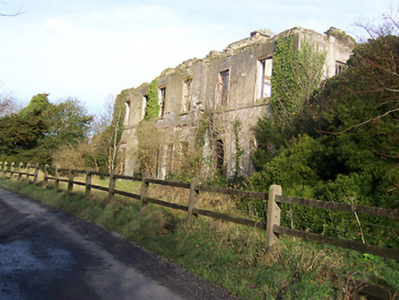
| Ballynagall | Ballynagall, a six-bay two-storey Regency style house, built in the early 19th century for James Gibbons at the cost of £30,000 (Lewis) and was reputedly built using the fabric of an existing castle on site, known as Castle Reynell (boi). Reynell of Castle Reynell is recorded on the Taylor and Skinner maps of the late 1770s. The interior plasterwork was executed by George Stapleton, son of the stuccadore Michael Stapleton. The Smyth Papers in the National Library contain letters to James Gibbons from John Robinson and Francis Johnston relating to the building of Ballynagall, 1810-1815 (Mss 18,926-18,927). Ballynagall remained in the possession of the Gibbons family until 1846 when ownership passed to James Middleton Berry, nephew of James Gibbons. At the time of Griffith’s Valuation (publ. 1854) the buildings were valued at £110 and held by JWM Berry in fee. Inherited by Thomas James Smyth of the Drumcree family in 1855, it remained in Smyth ownership until sold in 1963 (O’Brien). It is now a ruin. |
|
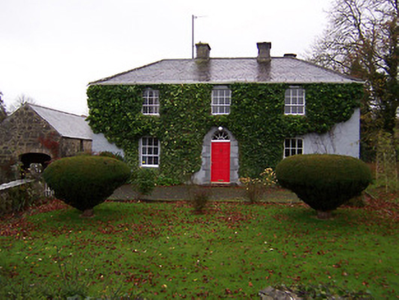
| Martinstown | Martinstown is marked on the first edition OS map but is named on the later 25 inch map. It was built c.1820, on a L-shaped plan with two-storey return to the rear (boi). John Kerr held most of this townland from Thomas R Evans at this time and occupied the house valued at £12. Other Kerr family members occupied houses valued at £7 and £8.10. |
|
| Kilmaglish | Kilmaglish House not built at time of first edition OS map but is marked on the 25 inch map. At the time of Griffith’s Valuation (publ. 1854) it was valued at £17, occupied by William Levinge and held from Sir Richard Levinge. Occupied by Thomas Robinson, a farmer and his son William in 1901 and 1911. It is still extant surrounded by large farmyard. | |
| Rathconnell Court | Rathconnell Court is named on the first edition OS map and marked as ruins on the 25 inch map of the early 20th century. It was the home of the Adams family and was marked on the Taylor and Skinner maps of the 1770s. Occupied by Francis Adams in the early 19th century and by J Adams in 1837. Francis Adams was resident at the time of Griffith’s Valuation (publ. 1854) holding the house valued at £18 in fee. | |
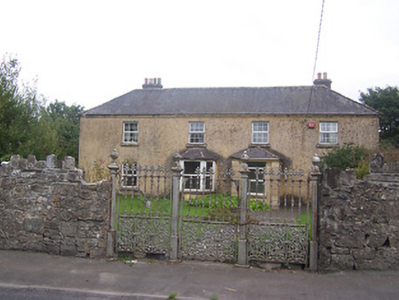
| Ballyglass | Ballyglass, a four-bay two-storey house, built about 1820, is named on both the first six inch and 25 inch OS maps and located just north east of St Finian’s College near Mullingar. In 1814 it was the home of John McLaughlin. At the time of Griffith’s Valuation (publ. 1854) James William McLoughlin resided, holding the house valued at £16.10 in fee. This house is still extant. |
|
| Culleen House | Culleen House is marked on the first edition OS map and had greatly expanded by the time of 25 inch, only the outbuildings remain now. O’Brien describes it as long, low seven-bay, two storey early Victorian house, purchased by Mr Mc Loughlin, a Dublin merchant, from Sir John de Blaquiere of Portloman. A Thomas McEvoy occupied Culleen in 1814. It was later sold to Godfrey Levinge, a grandson of the 4th Baronet, who was resident at the time of Griffith’s Valuation (publ. 1854), holding the house, valued at £30 in fee. Home of Thomas M Reddy and family at the time of the 1901 and 1911 censuses. This house is no longer extant. | |
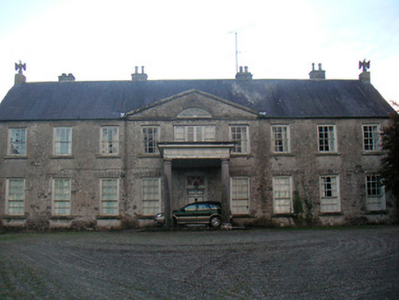
| Levington Park | Levington Park is located close to the southern shore of Lough Owel. The seat of a branch of the Levinge family from the mid-18th century, it is a nine-bay two-storey country house with two-storey returns to the rear at either end (north and south), built about 1748 by Sir Richard Levinge 4th Baronet and altered in the early 19th century (boi). In 1814 Lady Levinge was resident. It was inherited by the 4th Baron’s second son Richard Hugh Levinge who was the owner in 1837. Valued at £27 at the time of Griffith’s Valuation (publ. 1854), occupied and held by Charles William Levinge in fee. Members of the Levinge family were still resident in 1901 but Hugo Fitzpatrick and his wife Gertrude were living here in 1911. O’Brien writes that Levington Park was later the residence of Edmund Dease, formerly of Turbotstown House. His son Maurice was the recipient of the first posthumously awarded Victoria Cross of World War I. The house had other owners until purchased by the author J P Donleavy in 1972. He died in 2017. |
|
| Springfield (Mullingar) | Springfield, on the outskirts of Mullingar, is named on both the first six inch and 25 inch maps. At the time of Griffith’s Valuation (publ. 1854) it was occupied by Thomas Tuite, held from Charlotte Tighe and valued at £20. Now demolished and replaced by Assumption Villas. |