

Claremount House
Houses within 5km of this house
Displaying 10 houses.
Houses within 5km of Claremount House
Displaying 10 houses.
| House name | Description | |
|---|---|---|
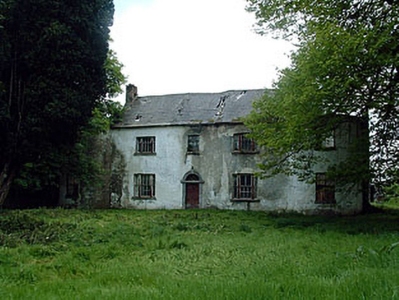
| Drumman Lodge | Drumman Lodge is named on first edition OS map. It is an early 19th century house of three-bays and two-storeys. In 1837 it was the home of T.M. Carew. At the time of Griffith’s Valuation (publ. 1854) Henry Green was the occupant, holding the house valued at £15 from an estate in Chancery, Rochfort v Brown. O’Brien writes that the Gavin family were resident between 1930s and 1980s and that the house has been recently restored. |
|
| The Cottage | The Cottage, Gallstown, is named on both the first edition OS map and the 25 inch. This was the seat of the North family at the end of the 18th century (O’Brien). By 1814 Hugh Sheil was resident and Lewis records Mrs Sheil of The Cottage. This family was related to the Sheils of Gortlumly. The house was occupied by Margaret Sheil at the time of Griffith’s Valuation (publ. 1854), valued at £10 and held from Lord Kilmaine. Home of employees of Lord Kilmaine in the early 20th century. The house is no longer extant. | |
| Gortumly | Lewis refers to John Sheil of Gortumly and a long building is evident in this townland on the first edition OS map. O’Brien writes that the Sheils were resident at Gortumly from the mid-18th century. Gortumly house is named on the 25 inch map and is located just south of the long building on the first edition map. O’Brien writes that the Sheils bequeathed the house to a Mr O’Neill about 1910. Patrick O’Neill, a farmer and clerk to the County Council, was resident with his family in 1911. The lands were later sold to the Land Commission and the house demolished. | |
| Enniscoffey | Named on the first edition OS map and the 25 inch map, this was a late 18th century two-bay, two-storey house built in front of an older house. In 1837 Mark Anthony Levinge was residence, as he was also at the time of Griffith’s Valuation (publ. 1854), when the house was valued at £34 and held with over 900 acres from Daniel Molloy. Tenison Levinge and his wife were the occupants in 1901 and 1911. The house is now demolished. | |
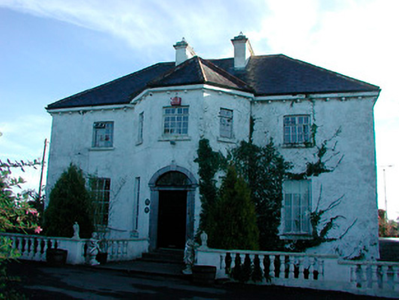
| Woodville | Named on the first edition OS map, this is a three-bay two-storey over basement country house, built about 1785. At the time of Griffith’s Valuation (publ. 1854) it was the home of John G O’Keeffe, who held the house valued at £10.10 from Daniel Molloy. Functioned as a restaurant for a time and was recently for sale. |
|
| Gaybrook House | This house was built on land originally belonging to the Gay family who sold it to Ralph Smyth before the end of the 18th century. Smyth built the three-storey three-bay house which had extensive outbuildings and pleasure grounds as shown on the first edition OS map. Leet records him as the occupant in 1814 and his widow Mrs A Smyth was resident in 1837. Their son Robert was the occupant at the time of Griffith’s Valuation (publ. 1854) holding the house valued at £95 in fee. Col James Smyth and family were resident at the beginning of the 20th century. The house was demolished by the Land Commission about 1960 (boi). | |
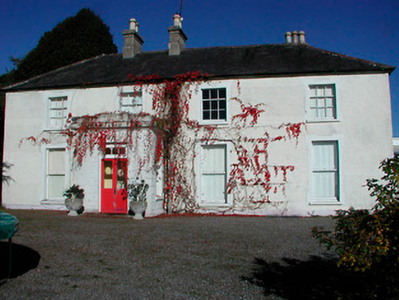
| Rathcam or Lemongrove House | Rathcam House, previously known as Lemongrove, is a four-bay two-storey house, built about 1830 to replace an earlier house. Lemmongrove is marked on the Taylor and Skinner maps of the late 1770s occupied by Wilton Esq. Joseph Lemmon of Lemmongrove is mentioned in a deed of assignment dated 1771. Leet records Joseph Lemon of Lemongrove in 1814. Valued at £18, it was occupied by John ‘Lennon’ at the time of Griffith’s Valuation (publ. 1854) and held from Christopher Wilson [Wilton?]. The Lemons were still resident at the beginning of the 20th century. John D Lemon was the occupant in 1906 when the mansion house was valued at £23 and held with 262 acres of untenanted land. |
|
| Larkfield House | Larkfield House, situated in the southern half of the small 17 acre townland of Clonmoyle, its demesne was situated to the south in the townland of Vilanstown. It is named on the first edition OS map. In 1837 it was occupied by Francis Pratt Smyth, who was also resident at the time of Griffith’s Valuation (publ. 1854) when the house was valued at £20.15 and held from Frederick Lestrange. Larkfield was still in the possession of the representatives of the Rev Samuel L’Estrange when it was part of a sale of Violetstown in the Encumbered Estates Court on 4 July 1874. Mrs Henrietta Hodson and her daughter occupied the house in 1901 and in 1911. The site is now a green field. | |
| Gallstown | Gallstown/Gaulstown House was a large country house with extensive grounds as shown on the first edition OS map on which the house is named as Castletown, although the Taylor and Skinner map of the late 1770s refer to the house as Gaulstown Park. Its name changed to Gallstown House on the 25 inch map. It was an 18th century, three storey, seven-bay Palladian style house built by the 2nd Earl of Belvedere to replace the house in which his mother was imprisoned for over thirty years. In 1784 Sir John Browne of The Neale, Co Mayo, later 1st Baron Kilmaine, purchased the house from the 2nd Earl of Belvedere. Lord Kilmaine was recorded as resident in 1814, 1837 and at the time of Griffith’s Valuation (publ. 1854). Lewis refers to Gaulstown Park as the ‘splendid seat of Lord Kilmaine in the grounds of which is a very large larch tree, planted by Dean Swift’. The house was valued at £66 in the mid-19th century. O’Brien writes that the 5th Baron Kilmaine sold the house at Gallstown in 1918 and it was burnt in 1921 and the ruins demolished in the 1950s. | |
| Lowtown House | Lowtown House described by O’Brien as a late 17th century, two-storey, nine-bay house over a basement built by Anthony Dopping, Bishop of Meath. Generations of Doppings lived here including four successive Anthonys. The house is referenced in Taylor and Skinner maps of the 1770s. In 1814 Samuel Dopping resided and in 1837 his son William lived here. In 1843 William married Jane daughter of the Rev Cecil Crampton and they emigrated to Australia, as did his older brother Anthony John some years later. William Dopping and his mother Anne of Lowtown appear to have been having financial difficulties in 1842 as two judgements against them for a debt of £1,840 was assigned to Philip Crampton, Lowtown, Co Westmeath MD and George Ribton Crampton, Upper Mount St, Dublin, see Dopping-Hepenstal Papers in NLI Ms. 35,871 (7). Anne Dopping, widow of Samuel, was living in the house at the time of Griffith’s Valuation (publ. 1854). It was valued at £28 and she held it in fee. Occupied by Eleanor Mary Crampton at the beginning of the 20th century and then by the Glennon family. Sold to the Land Commission in the 1950s the house was subsequently demolished and is now a green field site. |