

Cornaher
Houses within 5km of this house
Displaying 7 houses.
Houses within 5km of Cornaher
Displaying 7 houses.
| House name | Description | |
|---|---|---|
| New Forest | New Forest is a five-bay three-storey over basement country house, built in the 1770s by the Evans family and acquired by Henry Daniel before the end of the century. In 1837 New Forest was the home of a H. Daniel described by Lewis as ‘one of the most complete and gentlemanly residences in the county of Westmeath’. In 1843 Henry was succeeded by his son Robert Daniel who Griffith’s Valuation (publ. 1854) records was the occupant holding the house valued at £55 from Francis Evans. When the Evans estates in counties Mayo, Monaghan and Westmeath were for sale in the Landed Estates Court in November 1871, Newforest was described as forming 'one of the most complete and gentlemanly residences in the county of Westmeath'. (LEC rental 14 November 1871). O’Brien writes that the Daniels bequeathed the estate to the Catholic Church in the 20th century. It was sold in 1948 to Lt-General Sir Charles Gairdner, who was later appointed Governor of Western Australia (1951–1963) and then Governor of Tasmania (1963-68). Its extensive mature landscaped grounds are now in use as a golf course and the house is a hotel see https://newforest.ie/ | |
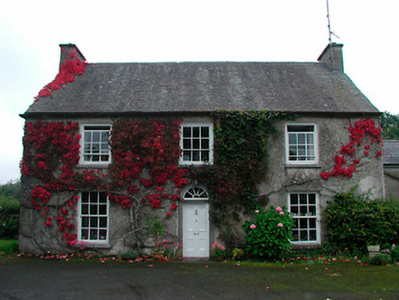
| Knock House | Knock house is marked on the first edition OS map and named on 25 inch. It is a three-bay two-storey house with a return, built about 1815 and still extant. At the time of Griffith’s Valuation (publ. 1854) the house was occupied by John Robinson who held it from Sir William Leeson. It was valued at £10. |
|
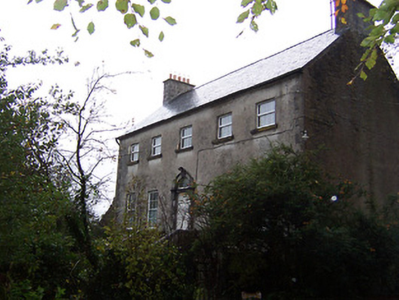
| Guilford House | This land was originally the property of the North family who were connected to the Earls of Guilford. A five-bay two-storey house over a raised basement, built in the late 18th century, possibly by the Reynolds family, but was leased to the Usher family by the end of the century. Occupied by Christopher Coffie/Coffey junior in 1814 and by F. Usher in 1837. At the time of Griffith’s Valuation (publ. 1854) Christopher Swift held the house valued at £12 from Francis Usher. O’Brien writes that the Reynolds family still own Guilford House. |
|
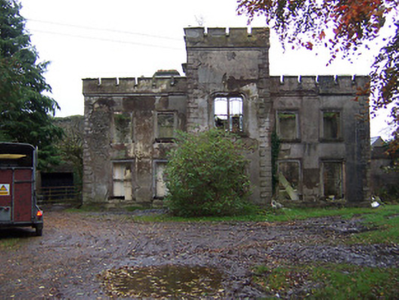
| Newcastle | A five-bay two-storey castellated country house, built or rebuilt in the mid-19th century by the Coffey family who bought the property from the Norths in the 1780s. It is now derelict. The National Built Heritage Service states that the remains of an earlier house built by the North family, c.1740, and a tower house built c.1640 can be seen to the rear (west). The Taylor and Skinner maps record Newcastle as the property of the Norths. In 1814 and 1837 Newcastle was the home of Christopher Coffey. At the time of Griffith’s Valuation (publ. 1854) Richard Coffey was resident, when the house valued at £30 was held from Charles B Marley. The house would appear to have been unoccupied at the beginning of the 20th century. |
|
| Templeoran House | Templeoran House, named on the first edition OS map, this was a two-storey, five-bay late 18th century house which O’Brien states has been an ivy covered ruin for many years. In 1837 Mrs Johnson was resident and at the time of Griffith’s Valuation (publ. 1854) the house was the home of Edward Fetherstonhaugh, valued at £8.10 and held from George A Boyd. | |
| Tore | This house is named Toor on the first edition OS map and Torr on the 25 inch map. Located a short distance south east of Tyrrellspass, it was a two-storey, five-bay 18th century house, built by the Pilkington family and marked on the Taylor and Skinner map of the late 1770s. Henry Pilkington of Tore was a subscriber to Lewis’ Topographical Dictionary. The house was occupied by him at the time of Griffith’s Valuation (publ. 1854). Valued at £25 it was held from Charles B Marlay. Henry Mulock Pilkington of Tore owned 1,683 acres in county Westmeath in the 1870s. The house was burnt in the early 1920s and is now a ruin. | |
| Rahugh House | Located close to a graveyard and ruined monastery, Rahugh House is named on both the first edition six inch and the 25 inch OS maps. William Bagnell lived here in 1814. James Bagnell was the occupant at the time of Griffith’s Valuation (publ. 1854), holding the house, valued at £13.5 from Charles B Marlay. On 9 May 1873 the estate of William Bagnall, a minor, at ‘Rahue and Knockroe’ was for sale in the Landed Estates Court. The petitioner was Abraham Bagnall. The house was described in the sale rental as a ‘Substantial dwelling house’ and had ‘commodious out-offices’. At the turn of the 20th century Walter Newburn, a farmer and his family were resident and in 1911 James L Hodgins, also a farmer and his family were living at Rahugh. The house is extant. |