

Cloonbonny
Houses within 5km of this house
Displaying 9 houses.
Houses within 5km of Cloonbonny
Displaying 9 houses.
| House name | Description | |
|---|---|---|
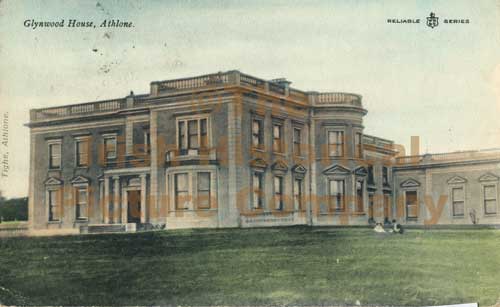
| Glynwood House | Glynwood house is located east of Athlone. The original house was constructed about 1790 by Francis Longworth and rebuilt about 1860 by John Longworth (1798-1881). A new house in the Italianate style was built in the early 1880s for Francis Travers Dames Longworth to the design of George Moyers. On 1 February 1918, a few lines in the Belfast News-Letter stated that Glynwood House, Athlone, the family mansion of the Dames-Longworth family, had been destroyed by fire. It is now an ivy covered ruin. See https://houseandheritage.org/2018/02/01/glynwood-house/ The present Glynwood House, formerly the agent’s house is located to the northwest of the site of the original Glynnwood House and dates from the late 19th century. |
|
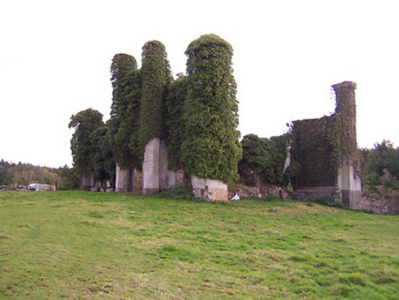
| Moydrum Castle | The National Built Heritage Service states that Moydrum Castle is a Gothic Revival castellated country house built circa 1812 to designs by Sir Richard Morrison (1767-1849), who was commissioned by William Handcock to rebuild an existing house befitting of his new status as Lord Castlemaine. Lewis describes it as ‘a handsome castellated mansion, erected in 1814’. It was valued at £75 in the mid-19th century. The building remained the home of the Castlemaines until it was burnt down on 3 July 1921. A photograph of the remains featured on the cover of the U2 album ‘The Unforgettable Fire'. |
|
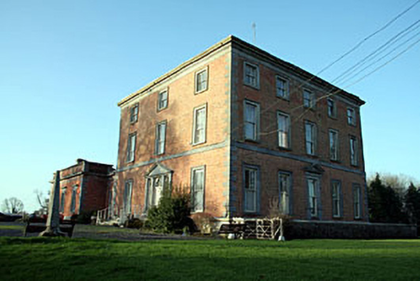
| Ballynahown | Ballynahown built in 1746 by Edmond Malone (lawyer and later MP for Granard) and his wife Ruth Malone nee Judge. It is a building of three storeys over a basement, having a three-bay single-storey wing, added c.1850 by the Ennis family. The National Built Heritage Service states that this grand house is unusual in that it is constructed of brick, a very rare building material in Westmeath at the time of construction. In 1837 Lewis wrote that Ballynahown was the ancient residence of the Malone family, built on the site of an old castle and now unoccupied, having passed into other hands. Andrew Ennis bought the house in 1828. He was a wealthy Catholic merchant and business man who bought up land in the Athlone area of County Westmeath. His son John Ennis became a Governor of the Bank of Ireland and was knighted in 1866. He occupied the house at the time of Griffith’s Valuation (publ. 1854) when it was valued at £15. Sir John was succeeded by his son Sir John James Ennis who died in 1884 and was succeeded by his sister Marie Sophie who was married to Daniel O’Donaghue of the Glens. The O’Donaghues continued to own Ballynahown until they sold it in 1968. It remains a well maintained residence. |
|
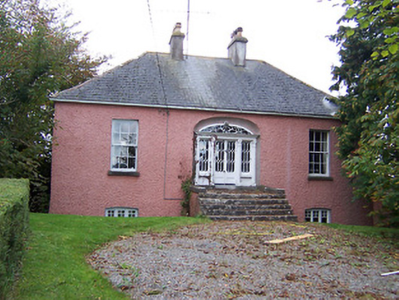
| Fardrum House | Fardrum House, an early 19th century house, named on the first edition OS map. Described by the National Built Heritage Service as a highly appealing early nineteenth-century gentleman’s cottage. Valued at £12 at the time of Griffith’s Valuation (publ. 1854) it was occupied by Eliza Mathews who held it from John Ennis. Later occupants have been the Robinson and Campbell families and it remains a family residence. |
|
| Auburn House | Auburn House located on the eastern outskirts of Athlone town is described by O’Brien as a late 18th century, two-storey, three bay house built by James Sproule about 1790. Occupied by the Bruce family of Gore House, Northgate Street, for about fifteen years before they emigrated to Australia. W S Bruce was resident in 1837. At the time of Griffith’s Valuation (publ. 1854) Laurence or Lorenzo Dundas was resident, holding the house valued at £22 from George Mechum. in 1894 Slater noted it as the residence of George A.G. Adamson, J.P. Various persons occupied this house in the following years including the Mahon and Browne families in the 20th century. Sold to the state in the 1960s it became a ruin and is now demolished. The Athlone Regional College now occupies the site. | |
| Mountain View Cottage | This building is named as Mount View Cottage on the first edition OS map and Mount View on the 25 inch map. O’Brien writes that Mount View on the Moate road is a two-storey, three-bay Victorian house built by a Mr Vaughan in 1866. At the time of Griffith’s Valuation (publ. 1854) the previous house on this site, valued at £10, was occupied by Mrs Diana Sproule, who held the property from Robert Jameson. The present house was a McNamara home in the 20th century and is still extant. | |
| Creggan House | Creggan House, located just south east of Athlone town and south of Creggan Castle. This house is named on the first edition OS map. It was a two-storey, three-bay house built by the Longworth family in the early 19th century. Peter Longworth was a Cromwellian soldier who settled at Creggan Castle in the mid-17th century. The Longworth family continued to inhabit Creggan House for much of the 19th century, Francis Longworth being recorded as the occupant in 1837. Henry Norwood Trye was resident at the time of Griffith’s Valuation (publ. 1854), holding the house valued at £24 from his brother-in-law Francis Longworth. It was occupied by land agent Peter Metge and his family in 1901 and by widower Thomas Davies Longworth and his daughters in 1911. The house was burnt down in 1921 when occupied by a Major Montgomery and subsequently demolished. | |
| Woodville | Hawthorn Cottage is named on the first edition OS map and on the 25 inch map as Woodville. ‘The Cottage’ was the seat of William Cooke in 1837 and at the time of Griffith’s Valuation (publ. 1854) when the building was valued at £16 and held from Lord Castlemaine. O’Brien writes that the Bourke family were in possession in the late 19th and early 20th centuries. The house was demolished post 1950. The site is now among state and industrial buildings located on the east side of Athlone. | |
| Retreat | Retreat was a two-storey, three bay late 18th century house built by Thomas Cooke and located close to the east side of Athlone town. It was occupied by General Hart in 1814, F E Moony in 1837 and by Major Owen Lloyd Ormsby at the time of Griffith’s Valuation (publ. 1854), who held the property valued at £20 from William Cooke. Later occupants of this house were the Costello, Kilduff and Young families. The house and lands were sold to the Athlone Urban District Council in 1998 and the house demolished. |